English
Choose your country/region and language
Your experience may change as only information for the country or region you select will be presented.


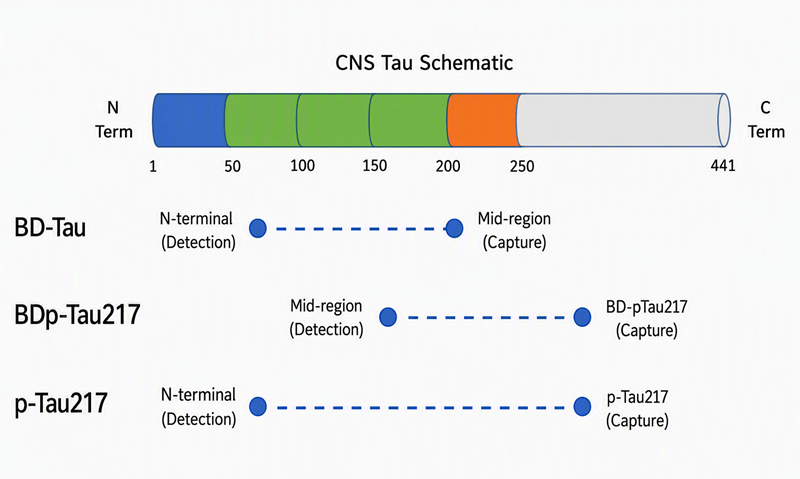
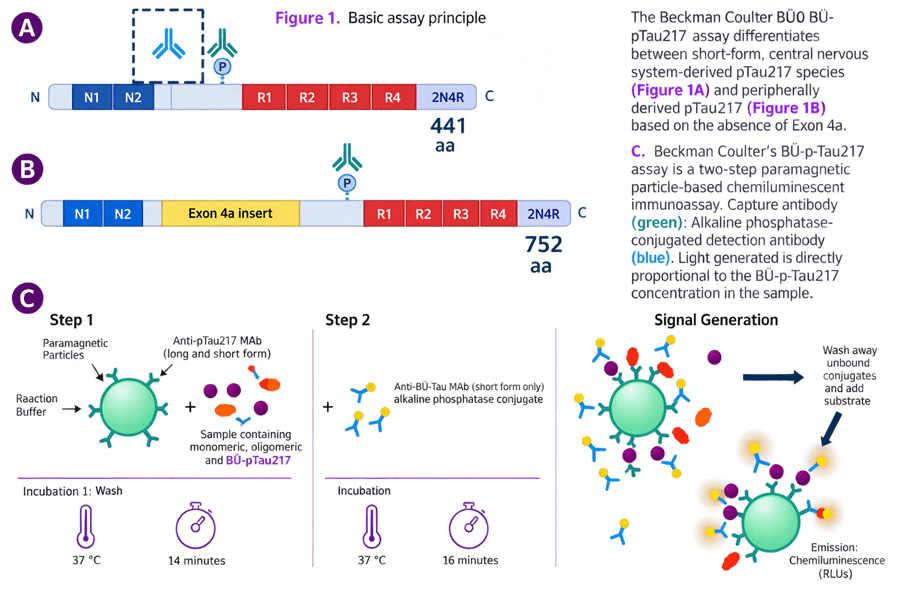
Emerging research indicates that determining brain-derived phosphorylated Tau217 (BD-pTau217) levels may improve differentiation between individuals with or without Alzheimer’s disease (AD) pathology.1,2 The Beckman Coulter BD-p-Tau217 research-use-only (RUO) assay is designed to selectively detect the phosphorylated Tau217 species originating from the central nervous system (CNS), reducing the contribution of peripherally expressed Tau isoforms that may be present in conventional plasma p-Tau217 measurements.
BD-pTau217 is being investigated as a potentially more specific blood-based biomarker for AD, particularly in populations where peripheral sources of Tau could influence traditional p-Tau217 measurements.3
The ACCESS BD-pTau217 RUO assay measures brain-derived p-Tau217, which may reduce peripheral tau interference, supporting cleaner interpretation of amyloid-related biology in research populations and enabling investigation of biomarker changes over time.
Delivering consistent performance at scale
| Assay Characteristic | Access BD-pTau217 (RUO) |
| Assay format | Two-step, sandwich |
| Recommended sample type | Plasma (K2 EDTA) |
| Unit of measure | pg/mL |
| Analytical Measuring Range (approximate) | 0.03 – 10 pg/mL |
| Linearity | >-5.8 – 8.3% across measuring interval |
| Imprecision | <10% Within-lab CV |
| Open reagent pack stability | 2°to 10 °C for 31 days |
| Open calibrator vial stability | 2° to 10 °C for 31 days |
| Open QC vial stability | 2° to 10 °C for 31 days |
| Time to first result (approximate) | 38 minutes |
| Sample volume (uptake) | 210 μL plasma |
| Analytical sensitivity | LoB: 0.02 pg/mL |
| LoD: 0.03 pg/mL | |
| LoQ: 0.05 pg/mL |
References:
1. Chong JR, Hilal S, Venketasubramanian N, et al. Plasma brain-derived p-Tau217 outperforms other p-Tau species in detecting abnormal brain amyloid in an Asian cohort of older people with cerebrovascular disease burden. J Prev Alzheimers Dis. 2026;13(7):100615. doi:10.1016/j.tjpad.2026.100615
2. Jiang Y, Zheng W, Xia Z, et al. Head-to-head comparison of brain-derived pTau217 and total pTau217 for brain amyloid and tau pathology classification. Proc Natl Acad Sci USA. 2026;123(10):e2536792123. doi:10.1073/pnas.2536792123
3. . Gonzalez-Ortiz F, et al. Brain-derived tau: a novel blood-based biomarker for Alzheimer’s disease-type neurodegeneration. Brain. 2023;146(3):1152-65.
4. Dr. Wagner Brum, personal communication
MAPSS-3398-GBL-EN-v1